Flowing Forms of Discontinuity in Life
Curated by Ross Lovegrove
Designer: Ross Lovegrove
Company: Henraux
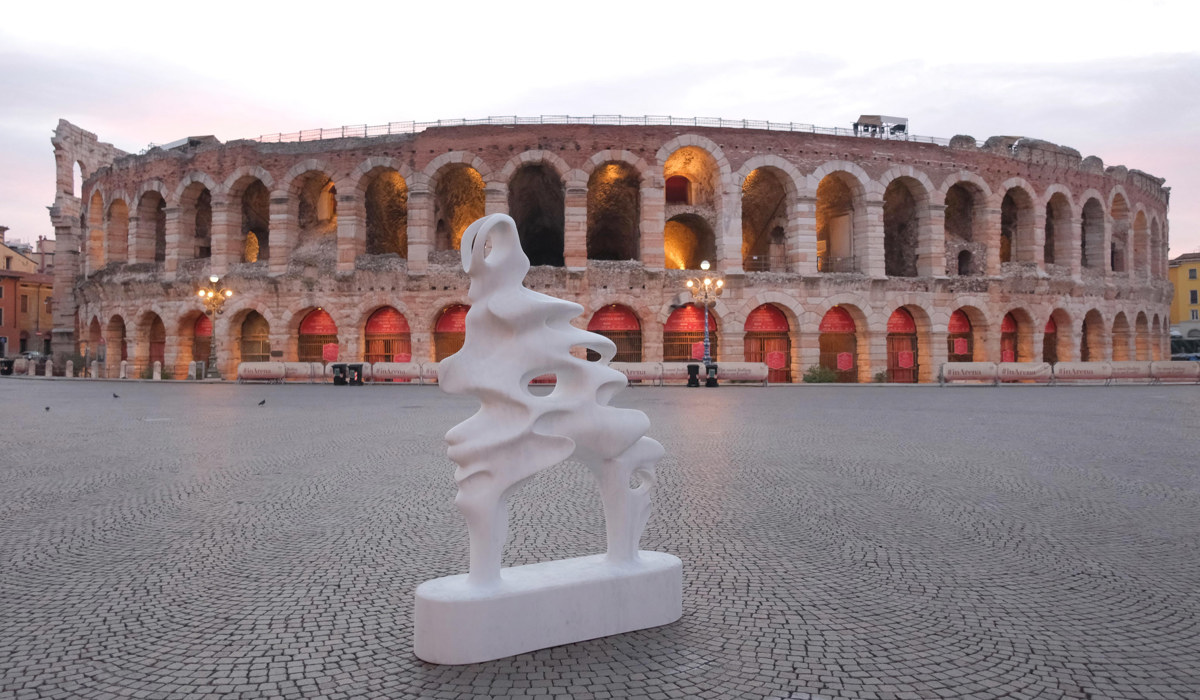
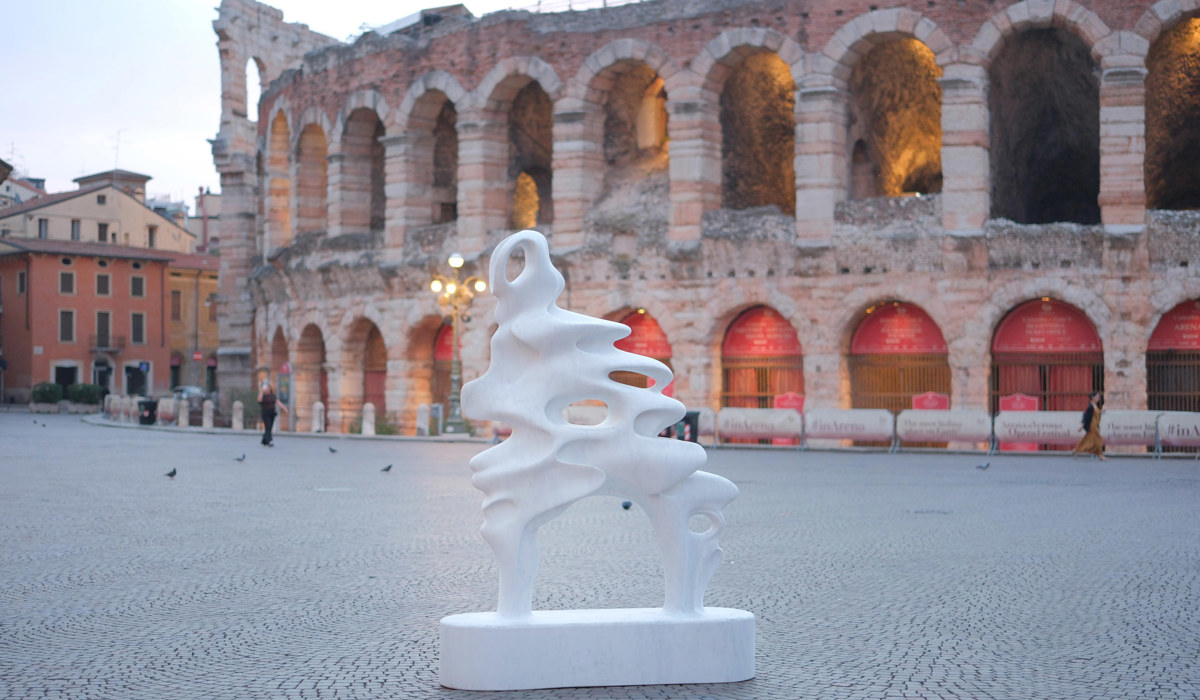
This sculpture continues my creative vision of extending Futurism into the twenty-first century.
It suggests a hybrid human form—part anatomical, part oid—caught in a state of fight or flight, converging with or diverging from the uncertainties of an emerging agentic life unfolding without our consent.
It conveys a form of energy in motion that speaks to our emotional and instinctive intelligence, frozen in marble for future generations as part of the archaeology of the future.
The Work
The Creator

Ross Lovegrove
Designer
Biography
Ross Lovegrove has been at the forefront of shaping the world around us for almost five decades. His work has received numerous international awards and is held in the permanent collections of many of the world's leading museums, including the Museum of Modern Art (MoMA) in New York, the Solomon R. Guggenheim Museum, and the Centre Pompidou in Paris.
His practice brings together art, design, advanced materials and technology to create a distinctive organic, biomorphic language that extends the principles of the natural world.
Renowned for an aesthetic that is both unique and timeless, Lovegrove anticipated the evolution of design from the analogue to the digital age and now draws inspiration from the possibilities of advanced digital intelligence.
Among his most significant projects are the immersive First Class cabin interiors for Japan Airlines, research projects for Apple, including the Apple Ammonite, the world's first inductively rechargeable digital camera for Olympus (1990), early concept designs for the first generation of Sony Walkman, seven years as Creative Director for TAG Heuer, the GT110—the world's lightest tri-axial carbon fibre suitcase for Globe-Trotter—and the iconic GO Chair for Bernhardt Design (2001), the first chair in the world to be manufactured using injection-moulded magnesium.
In 2017, the Centre Pompidou dedicated a 1,000-square-metre retrospective, Convergence, to his work, recognising Lovegrove as the designer who pioneered the transition from the twentieth to the twenty-first century—from the mechanical to the biological, and from the analogue to the digital—through an extraordinarily diverse body of work.
Lovegrove has delivered two TED Global talks. The first, Inspired by Nature (2006), featured alongside figures including Craig Venter, Janine Benyus and James Watson. His second, Lovegrove Genesis (Oxford, 2013), anticipated the emergence of algorithmic, data-driven and automated design capable of moving beyond the limitations of human intelligence towards fully optimised systems. He envisioned products that are dematerialised, resource-efficient and engineered at the nanoscale, supporting a more sustainable industrial future.
Today, his work operates at the intersection of art, biology and physics. He collaborates with Polaris Dawn Space Flight Data and is currently working with Google DeepMind in the United States, exploring how artificial intelligence and emerging interfaces can create a new, profoundly biological relationship between humans and machines through design.